Architecture Drawing Easy Basic Design Guide
- 1.
Why “architecture drawing easy” Isn’t Just for the Picasso-in-Residence
- 2.
Breaking Down the Myth: “Can I Be an Architect If I Can’t Draw?”
- 3.
Tools of the Trade: Keep It Simple, Keep It Real
- 4.
Getting Your Bearings: Basic Lines, Shapes, and Spatial Logic
- 5.
Step-by-Step: How to Draw an Architectural Drawing (Even If You Think You Can’t)
- 6.
Finding Your Flow: Daily Sketching Habits That Stick
- 7.
From Doodles to Drafts: Bridging Hand Sketches and Digital Tools
- 8.
What Is the Easiest Drawing to Make? (Hint: It’s Architecture-Adjacent)
- 9.
Common Pitfalls (And How to Dodge ’Em Like a Pro)
- 10.
Where to Go From Here: Your Next Move in the Sketching Game
Table of Contents
architecture drawing easy
Why “architecture drawing easy” Isn’t Just for the Picasso-in-Residence
Ever looked at a blank sheet of paper and thought, “Man, I couldn’t draw a straight line if my coffee depended on it”? Trust us—you’re not alone. But here’s the tea: “architecture drawing easy” doesn’t mean you gotta be Van Gogh with a drafting table. Nope. It’s about getting your brain to talk to your hand in a language both understand—lines, shapes, and a sprinkle of spatial swagger. Whether you’re sketching a backyard shed or dreaming up a downtown loft, “architecture drawing easy” is your golden ticket to start visualizing ideas without needing a protractor tattooed on your forearm. Architecture isn’t just steel and glass—it’s first born in the scribbles of beginners.
Breaking Down the Myth: “Can I Be an Architect If I Can’t Draw?”
Let’s squash this myth like a soda can at a tailgate. The answer? Heck yeah, you can. Modern architecture leans heavy on software—think Rhino, Revit, SketchUp—but having a handle on “architecture drawing easy” basics sharpens your design intuition. Hand sketching lets you brainstorm faster than your laptop boots up. You don’t need museum-worthy strokes; you need clarity, proportion, and a pinch of confidence. “Architecture drawing easy” is the warm-up lap before the main race, not the finish line. And newsflash: even starchitects started with wobbly rectangles and wonky windows.
Tools of the Trade: Keep It Simple, Keep It Real
You don’t need a suitcase full of fancy gear to dive into “architecture drawing easy.” Start with a trusty pencil (0.5mm mechanical? Classic.), a decent sketchbook with grid lines, and maybe an eraser that doesn’t crumble like stale cornbread. Throw in a ruler if you’re feeling extra precise—but seriously, half the charm of beginner “architecture drawing easy” is in the imperfections. That slightly crooked chimney? It’s got character, like your grandpa’s old pickup truck. Keep your kit light, your mindset lighter.
Getting Your Bearings: Basic Lines, Shapes, and Spatial Logic
Before you go dreaming of Frank Lloyd Wright-level masterpieces, master the ABCs: straight lines, right angles, circles that kinda close. “Architecture drawing easy” thrives on simplicity—start with a cube, then a window, then a roof that actually sheds rain. Learn one-point perspective: it’s like training wheels for your drafts. Draw a horizon line, throw in a vanishing point, and—boom—your flat box suddenly lives in 3D space. Every skyscraper started as a square on someone’s napkin. Yours might too.
Step-by-Step: How to Draw an Architectural Drawing (Even If You Think You Can’t)
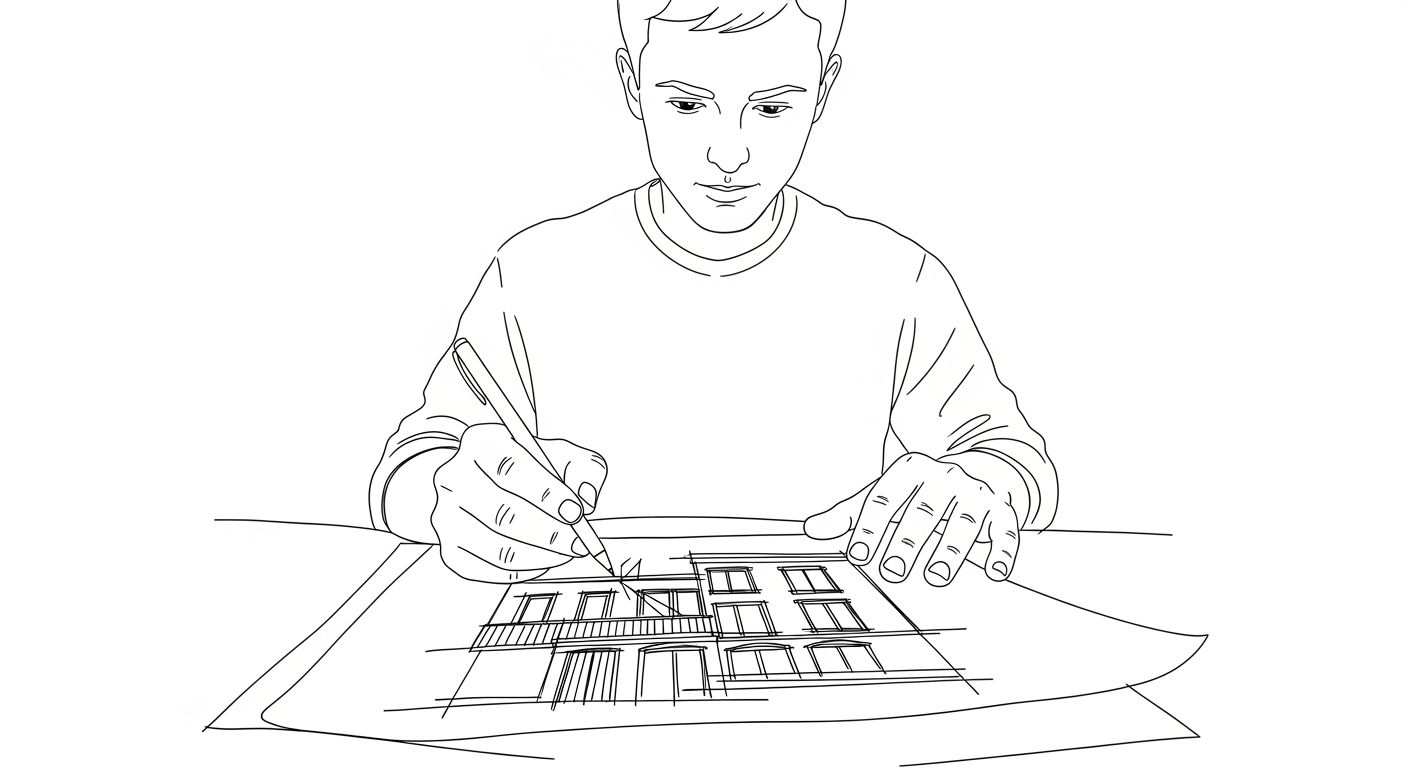
Alright, buckle up, buttercup. Here’s your no-sweat roadmap to “architecture drawing easy” glory:
1. Sketch your base—a rectangle for the footprint.
2. Add vertical lines for height—keep ’em parallel.
3. Connect the top to cap your volume.
4. Punch in windows and doors using proportional spacing.
5. Shade lightly to show depth—north-facing walls get shadow, south gets sun (in the Northern Hemisphere, y’all).
This ain’t rocket science—it’s architecture drawing easy, and it works whether you’re in Brooklyn or Boise. Just keep your pencil moving and your inner critic on mute.

Finding Your Flow: Daily Sketching Habits That Stick
You won’t wake up one morning suddenly fluent in “architecture drawing easy”—it’s built like muscle. Ten minutes a day sketching your coffee shop, your neighbor’s porch, or that funky gas station with the tin roof? That’s your dojo. Consistency beats intensity every time. Keep a small pad in your truck, your backpack, your fanny pack (hey, they’re back). Miss a day? No biggie. The key is returning—not perfection. Over time, your “architecture drawing easy” sketches stop looking like toddler doodles and start breathing like real design.
From Doodles to Drafts: Bridging Hand Sketches and Digital Tools
Once your “architecture drawing easy” habit takes root, it’s time to flirt with pixels. Use your hand sketches as underlays in SketchUp or Illustrator. That rough elevation you drew on the bus? Trace it digitally, refine it, scale it. The tactile feel of paper keeps your ideas raw and human; the software polishes them for clients or permits. Think of it like BBQ—your sketch is the smoke, the software is the sauce. Both matter, but one’s got soul.
What Is the Easiest Drawing to Make? (Hint: It’s Architecture-Adjacent)
If you’re itching for a confidence boost, start with axonometric cubes—fancy term for 3D boxes drawn without vanishing points. They’re dead simple, endlessly useful, and scream “I know what I’m doing” even when you’re winging it. Or sketch a front elevation of a tiny house: flat facade, door centered, two windows flanking it like bookends. That’s “architecture drawing easy” in its purest, most approachable form. No curves, no drama—just clean lines and quiet pride.
Common Pitfalls (And How to Dodge ’Em Like a Pro)
Newbies often overcomplicate “architecture drawing easy” by chasing realism too soon. Newsflash: architecture isn’t photorealism—it’s communication. Don’t get lost in brick textures before you’ve nailed your massing. Another trap? Ignoring scale. A door should be ~7 feet tall—not taller than your two-story house. Use your pencil as a measuring stick (“this window = half a door”). Keep it proportional, keep it clear, keep it “architecture drawing easy.”
Where to Go From Here: Your Next Move in the Sketching Game
Feeling that spark? Good. Now, don’t just sit there—Randall Enos is your home base for more design fuel. Dive into the Sketch category for weekly prompts and gear reviews. And if you’re itching to flex beyond buildings, check out our wild side with Crocodile Sketch Quick Wildlife Ideas. “Architecture drawing easy” is just the first chapter—you’ve got whole volumes ahead.
Frequently Asked Questions
Can I be an architect if I can't draw?
Absolutely—you can totally rock a career in architecture even if your “architecture drawing easy” sketches look like a raccoon doodled ’em. Modern tools handle precision; your job is to think spatially. Hand drawing helps with ideation, but it’s a skill you build, not a gatekeeper. Many architects start exactly where you are—and now they design hospitals, museums, and mountain cabins. So yeah, grab that pencil. Your future clients don’t care if your first cube had five sides.
How to draw Spider-Man in an easy way?
Whoa there, web-slinger—while Spider-Man’s cool, this here’s about “architecture drawing easy,” not superhero fan art. But since you asked: stick figures with web lines and a big ‘S’ on the chest’ll get you a smile at Comic-Con. For architecture? Focus on boxes, roofs, and light-shadow play. Save the Spidey poses for your kid’s birthday card. Buildings don’t need spandex—they need structure, scale, and a solid foundation. Much less sticky.
How to draw an architectural drawing?
Drawing an architectural drawing begins with “architecture drawing easy” fundamentals: choose your view (plan, elevation, or perspective), lay down light construction lines, define proportions, then refine details. Start with orthographic projections—front, side, top views—before tackling 3D. Use grid paper. Keep your lines clean but not rigid. Remember: an architectural drawing isn’t about art—it’s about communicating space, function, and form. And yeah, it’s easier than parallel parking in Manhattan.
What is the easiest drawing to make?
The easiest drawing that still screams “I’m learning architecture”? A one-point perspective of a simple room. Draw a rectangle. Add a horizon line near the middle. Pick one vanishing point. Draw lines from corners to that point. Add a back wall. Boom—you’ve got depth, scale, and instant “architecture drawing easy” cred. It’s so basic, your dog could (almost) do it. But you? You’re building a visual vocabulary, one box at a time.
References
- https://www.archdaily.com/987654/beginner-guide-to-architectural-sketching
- https://www.archpaper.com/2023/05/hand-drawing-still-matters-in-architecture
- https://www.designboom.com/architecture/how-to-start-architectural-sketching-for-beginners-04-2022