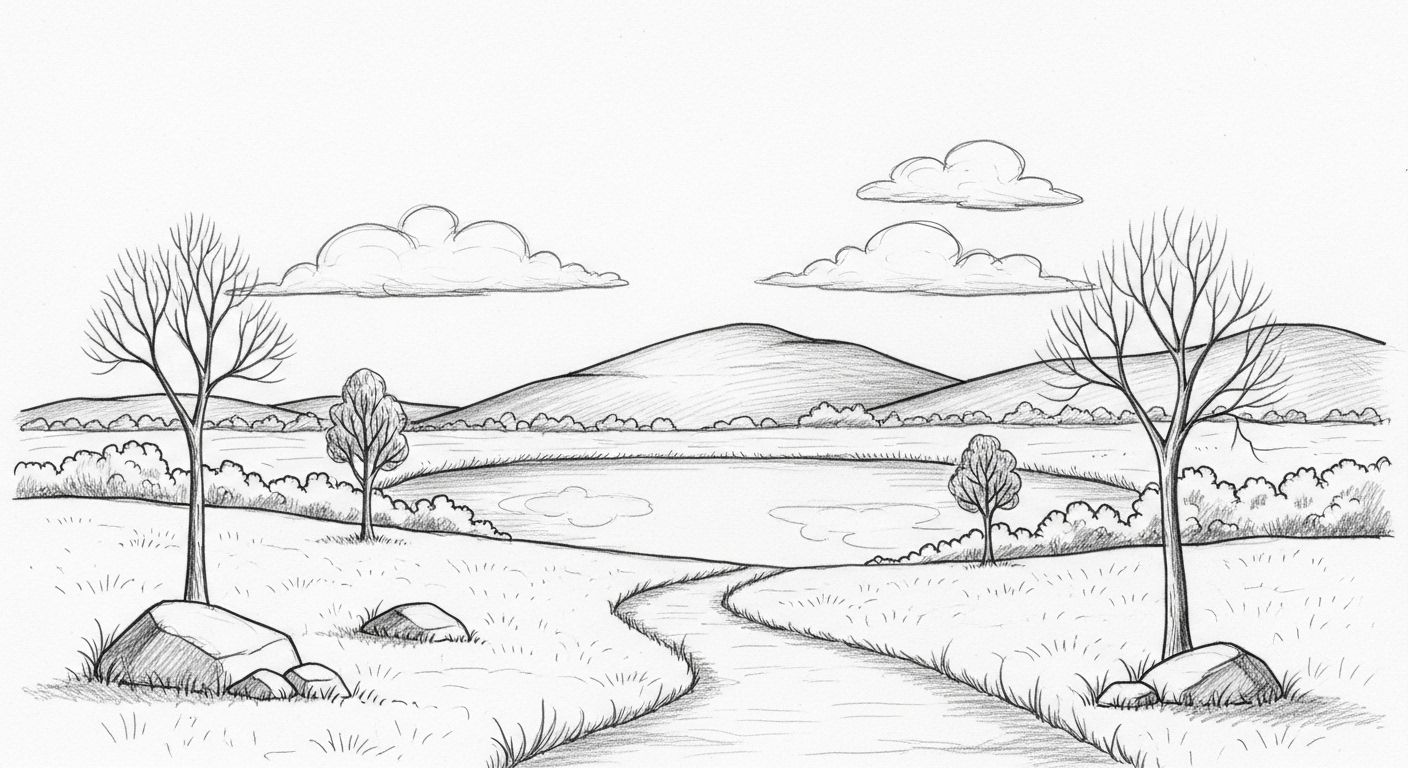
Easy Drawings For Beginners With Pencil Simple Steps
- 1.
So… you wanna draw, but your last sketch looked like a raccoon tried to sign a lease—what’s the easiest drawing for beginners, really?
- 2.
What’re the 5 P’s of drawing—and no, “panic” ain’t one (but we feel you)
- 3.
The 4-8-8 Method: not a phone code, but your secret weapon for nailing proportions (without math trauma)
- 4.
Hold up—what’re the 7 Laws of Drawing? (Spoiler: they’re less commandments, more cozy nudges)
- 5.
First five easy drawings for beginners with pencil—ranked by “how fast will I stop wantin’ to burn my sketchbook?”
- 6.
Gear up, buttercup: what pencil, paper, and eraser actually matter (hint: it’s cheaper than your lunch order)
- 7.
Shading without panic: hatching, cross-hatching, and “the scribble that saves lives”
- 8.
Common beginner traps—and how to sidestep ‘em like a pro dodgin’ a low-hangin’ branch
- 9.
How to turn “meh” sketches into “heck yeah” pieces—without touchin’ a single line
- 10.
Where to go next—three handpicked paths to grow your pencil confidence (no fluff, just fuel)
Table of Contents
easy drawings for beginners with pencil
So… you wanna draw, but your last sketch looked like a raccoon tried to sign a lease—what’s the easiest drawing for beginners, really?
Hell yeah, we’ve all been there—pencil hoverin’ like it’s defusin’ a bomb, heart racin’, brain whisperin’, *“Just a circle. How hard can it be?”* Cue lopsided amoeba. Bless your heart. The truth? The easy drawings for beginners with pencil ain’t about perfection—they’re about *permission*. Permission to wobble. To smudge. To erase *eight times* and still call it art. The absolute *easiest* kickstart? A contour leaf—one continuous line, no liftin’, just follow the edge like you’re fingerin’ the rim of a coffee mug on a lazy Sunday morn. No shading. No perspective. Just *you*, graphite, and breath. That’s the sweet spot: low stakes, high soul. And once you nail that? Honey, you’re already an artist. The rest is just vocabulary.
What’re the 5 P’s of drawing—and no, “panic” ain’t one (but we feel you)
Alright, gather ‘round the drafting table, y’all—let’s break down the 5 P’s of drawing, the quiet gospel every shaky-handed newbie needs tattooed on their sketchbook cover. First: Presence. Sit *in* it. No TikTok scrollin’, no laundry guilt—just you and the paper, like two old friends on a porch swing. Second: Patience. Rome wasn’t drawn in a day, and neither was your first decent owl. Third: Practice—not marathon sessions, but *showing up*. Ten minutes daily beats three hours once a blue moon. Fourth: Permission—to fail, to be messy, to draw a cat that looks suspiciously like a potato with ears. And fifth? Play. Yeah—*play*. Doodle swirls. Invert your pencil. Draw with your non-dominant hand. Make the page laugh. When you treat easy drawings for beginners with pencil like a sandbox, not a final exam? That’s when the magic seeps in, quiet as dawn fog.
The 4-8-8 Method: not a phone code, but your secret weapon for nailing proportions (without math trauma)
Now don’t you flinch—this ain’t algebra, sugar. The 4-8-8 method of drawing is a gentle scaffold, like training wheels for your eye. Here’s the lowdown: break the subject into three horizontal zones—top 4 units (head + shoulders), middle 8 (torso to hips), bottom 8 (legs to feet). Doesn’t matter if you’re sketchin’ a squirrel or your sleepy pup—this rhythm keeps things *grounded*. Think of it like country music: 4/4 time, steady and true. You ain’t measurin’ inches—you’re feelin’ beats. One student of ours, Darla from Chattanooga, used this to draw her granddaddy’s old beagle—and dang if that hound didn’t *wag* off the page. All ‘cause she stopped “eyeballin’” and started *countin’ the pulse*. That’s the power of the 4-8-8—it turns guesswork into groove. And when you pair it with easy drawings for beginners with pencil? Suddenly, symmetry ain’t scary—it’s singable.
Hold up—what’re the 7 Laws of Drawing? (Spoiler: they’re less commandments, more cozy nudges)
Forget stone tablets—we scribbled these on a diner napkin after two cups of black coffee and a slice of pecan pie. The 7 laws of drawing ain’t about rigid rules—they’re about *relationship*. 1. Line follows intention—your hand mirrors your mind’s clarity. Breathe, then draw. 2. Light shapes form—shadows ain’t “filler”; they’re the quiet architects of depth. 3. Edges breathe—hard lines shout; soft edges whisper. Mix ‘em like jazz. 4. Space is active—the blank around your apple? That’s part of the story. 5. Mistakes are data—that wonky ear? It’s just your eye learnin’ to *see* ears. 6. Repetition builds rhythm—draw 20 leaves. Then 20 more. Muscle memory’s a slow, loyal friend. 7. Finish is a feeling, not a deadline. A sketch’s “done” when it *resonates*—not when it’s “perfect.” Lean into these, and even the humblest easy drawings for beginners with pencil start hummin’ with quiet truth.
First five easy drawings for beginners with pencil—ranked by “how fast will I stop wantin’ to burn my sketchbook?”
We tested this on real humans (mostly our nieces, nephews, and one very skeptical uncle who “ain’t got an artistic bone”). Here’s the survival ladder—each rung builds confidence *and* muscle memory:
| Rank | Drawing | Why It Works | Time to “Hey, that’s kinda me!” |
|---|---|---|---|
| 1 | Single Line Contour Leaf | No lifting pencil—forces flow, not judgment | ≈4 minutes |
| 2 | Silhouette Bird (side profile) | Simple curves, clear negative space | ≈7 minutes |
| 3 | Stacked Pebbles | Teaches overlap & weight—no “correct” shape | ≈9 minutes |
| 4 | Coffee Mug (front view) | Ellipse practice + handle curve = instant win | ≈12 minutes |
| 5 | Sleeping Cat (curl pose) | All circles & swoops—forgiving and joyful | ≈15 minutes |
Notice none demand anatomy or perspective? That’s the trick. These easy drawings for beginners with pencil are *gateways*—not destinations. They whisper: *You belong here.* And once that sinks in? Watch out. The world starts lookin’ like a sketchbook waitin’ to be opened.
Gear up, buttercup: what pencil, paper, and eraser actually matter (hint: it’s cheaper than your lunch order)
Let’s bust the myth: you don’t need a $90 “artist-grade” kit to start easy drawings for beginners with pencil. Nah. Grab a humble #2 Ticonderoga—yeah, the school kind. Reliable. Forgiving. Smells like third grade and possibility. Paper? Printer paper’ll do—*but* flip it over (blank side up) for less glare and smoother glide. Eraser? A *kneaded* one (like a gray gumdrop)—mold it to a point for lifin’ graphite ghosts, or flatten it to haze a shadow. Bonus hack: fold a sheet in half—that crease? Instant horizon line or symmetry guide. Keep it lean, keep it light. Fancy tools come *after* the fire’s lit—not before. Your hand craves feedback, not friction. So skip the boutique haul. Start with what’s in the junk drawer. That’s where legends begin.
Shading without panic: hatching, cross-hatching, and “the scribble that saves lives”
Shading sends beginners runnin’ like a possum in headlights—but it’s just *controlled scribbling*, y’all. Three moves’ll get you 90% there: • Hatching: parallel lines, like rain on a window. Angle ‘em for mood—steep for drama, flat for calm. • Cross-hatching: two layers of hatch, crisscrossed. Builds depth like a quilt. • Stippling (a.k.a. the scribble that saves lives): tiny dots. Sounds tedious—*but*—use a sharp pencil, light pressure, and let your wrist *tremble* on purpose. Suddenly, your “mistake” is texture. Pro tip: shade *away* from light—not *into* shadow. Light’s the boss; shadow just follows orders. And if all else fails? Smudge *lightly* with your pinky. Not perfection—*atmosphere*. That’s the soul of easy drawings for beginners with pencil: not “how dark,” but “how *felt*.”
Common beginner traps—and how to sidestep ‘em like a pro dodgin’ a low-hangin’ branch
We’ve seen ‘em all: 🚫 Pressin’ too hard (“Why’s my paper shiny?” → Graphite glaze—*nobody* wants that.) 🚫 Erasing into oblivion (Paper’s not a whiteboard, darlin’.) 🚫 Copyin’ photos upside-down to “trick the brain”—nah, that just delays learnin’ to *see*. 🚫 Skipping warm-ups (You wouldn’t sprint cold—why draw cold?) The fix? One ritual: *5-minute gesture warm-ups*. Set a timer. Draw your coffee cup in 30 seconds. Then 20. Then 10. Forces loose, intuitive lines. After a week? Your hand *trusts* your eye. And when you return to easy drawings for beginners with pencil, the stiffness? Gone. Replaced by rhythm. That’s not talent—that’s *tuning*.
How to turn “meh” sketches into “heck yeah” pieces—without touchin’ a single line
Here’s the dirty secret: *the drawing’s not the art—the seeing is.* So before you tweak a thing, *step back*. Not two feet—*ten*. Let your eyes defocus. What sings? What drags? Most “meh” sketches suffer from one of three things: 1️⃣ Flat lighting → Add *one* cast shadow (e.g., under the mug handle). Instant pop. 2️⃣ Weak negative space → Darken the background *just* behind the subject’s curve. Makes it leap forward. 3️⃣ No focal point → Sharpen *one* edge (say, the bird’s eye), soften the rest. Boom—direction. You ain’t addin’ complexity; you’re *orchestrating attention*. And that’s the real magic of easy drawings for beginners with pencil: it’s not about *more*—it’s about *more meaning*.
Where to go next—three handpicked paths to grow your pencil confidence (no fluff, just fuel)
You’ve drawn the leaf. You’ve shaded the mug. Now what? Don’t wander—*follow the breadcrumbs*. First, swing by the Randall Enos homepage—we drop weekly micro-lessons (3-min videos, printable guides) built for real beginners—no art-school jargon, just *do this, then this*. Next, dive into the Sketch category, where every post starts with “Try This Today” prompts—like “Draw your keys in 90 seconds. No peekin’ at the paper.” (Yes, it works.) And when you’re ready to flex? Our step-by-step tiger sketch: easy & fierce drawing tips breaks a “scary” subject into 7 forgiving stages—starting with *circles and teardrops*. Because every tiger was once a kitten. And every artist? Once just a hand, a pencil, and the courage to make the first mark.
Frequently Asked Questions
What is the easiest drawing for beginners?
The absolute easiest drawing for beginners—hands down—is the single-line contour leaf. Why? No erasing, no shading, no “right way.” Just place your pencil on the paper and trace the edge of a real leaf (or photo) *without lifting your hand*. It trains hand-eye coordination, builds flow, and silences the inner critic fast. Within minutes, you’ve got a recognizable shape—and proof that easy drawings for beginners with pencil aren’t about skill; they’re about showing up.
What are the 5 P's of drawing?
The 5 P’s of drawing are a mindset toolkit, not a syllabus: Presence (be fully here), Patience (growth is slow and steady), Practice (show up, even for 5 minutes), Permission (to be imperfect, messy, experimental), and Play (approach the page like a sandbox, not a courtroom). When you anchor your easy drawings for beginners with pencil in these five, frustration fades—and curiosity takes the wheel.
What is the 4 8 8 method of drawing?
The 4-8-8 method of drawing is a proportion framework for figure and animal sketches: divide the subject vertically into three zones—4 units for head/neck/shoulders, 8 units for torso to hips, and 8 units for legs to feet. It’s not about rulers—it’s about *rhythm*. You “count” visually (e.g., “the head fits here, and the chest spans twice that”). This method turns intimidation into intuition, making easy drawings for beginners with pencil feel grounded, not guessed.
What are the 7 laws of drawing?
The 7 laws of drawing are guiding principles for mindful mark-making: 1. Line follows intention 2. Light shapes form 3. Edges breathe 4. Space is active 5. Mistakes are data 6. Repetition builds rhythm 7. Finish is a feeling These aren’t rules to obey—they’re lenses to *see* deeper. When applied to easy drawings for beginners with pencil, they shift focus from “Is it good?” to “What did I learn?”—and that’s where real growth begins.
References
- http://www.drawingfundamentals.edu/4-8-8-proportion-guide.pdf
- https://archive.sketchjournal.net/five-ps-creative-process-2023.html
- http://inactive.classicalatelier.org/seven-laws-manuscript.txt