Crime Scene Sketch Examples Top Ideas Now
- 1.
Understanding the Role of crime scene sketch examples in Modern Forensics
- 2.
The Four Essential Types of crime scene sketch examples You Gotta Know
- 3.
What Every Solid crime scene sketch examples Must Include
- 4.
Breaking Down the Four Types of Crime Scenes Through crime scene sketch examples
- 5.
Real-World crime scene sketch examples That Shook Courtrooms
- 6.
How Much Do Artists Behind crime scene sketch examples Actually Earn?
- 7.
Tools of the Trade: From Pencil to Pixel in crime scene sketch examples
- 8.
Why crime scene sketch examples Still Matter in the Age of Drones and 3D Scanners
- 9.
Common Pitfalls That Ruin Otherwise Good crime scene sketch examples
- 10.
How to Study and Master crime scene sketch examples Like a Pro
Table of Contents
crime scene sketch examples
Understanding the Role of crime scene sketch examples in Modern Forensics
Ever tried drawing your buddy after a wild night out, only to realize your stick-figure skills ain’t gonna cut it in court? Well, crime scene sketch examples are way more than just doodles—they’re legal-grade visual records that can make or break a case. Back in the day, long before body cams and drone footage, cops and investigators leaned hard on artists who could translate chaos into clarity. These crime scene sketch examples capture spatial relationships, object placements, and critical evidence with surgical precision. And while we’ve got fancy 3D scanners now, hand-drawn crime scene sketch examples still hold weight—especially when tech glitches or courtroom juries need something simple and human to wrap their brains around.
The Four Essential Types of crime scene sketch examples You Gotta Know
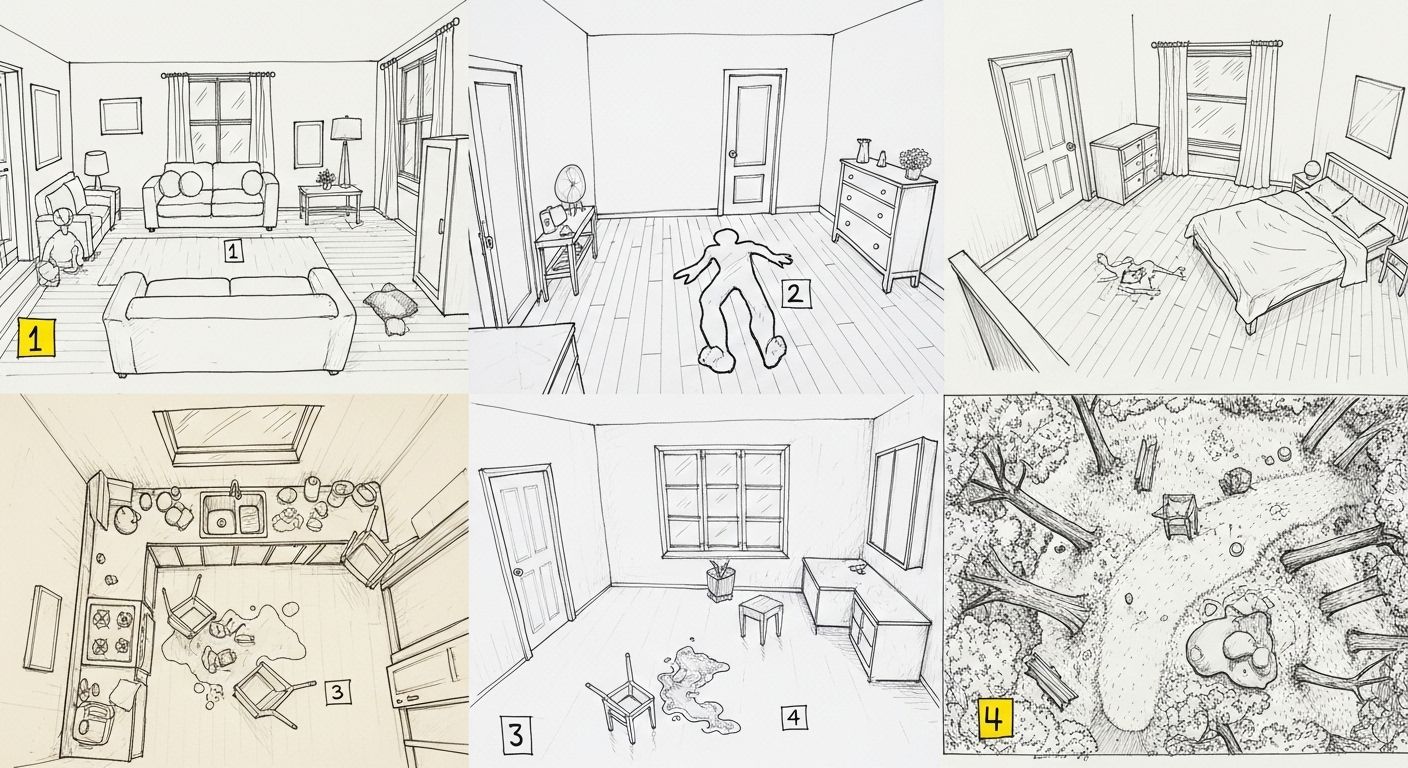
If you think all crime scene sketch examples look the same, you’re barking up the wrong alley. There are four main types, each serving a unique purpose: rough sketches (the raw, on-the-spot scribbles), finished sketches (polished for court), perspective sketches (3D-ish, for depth), and bird’s-eye or overhead sketches (top-down for layout logic). These crime scene sketch examples aren’t just about aesthetics—they’re forensic storytelling. A rough sketch might jot down blood spatter and shell casing placements with coffee-stained urgency, while a finished version cleans it up like a courtroom-ready blueprint. Both forms count as valid crime scene sketch examples, but their audiences differ: one speaks to cops on shift, the other to judges and juries.
What Every Solid crime scene sketch examples Must Include
Picture this: you’re handed a crime scene sketch examples that’s missing scale, direction, or evidence labels. Total disaster, right? A proper crime scene sketch examples always packs the essentials: a compass rose (north matters!), accurate measurements (usually in feet or inches), clear object labels (e.g., “9mm casing,” “bloody shoe print”), case number, date, location, and the artist’s signature. Don’t forget annotations—those little notes that explain why a lamp’s knocked over or how far the victim was from the door. These details turn a basic doodle into a legit piece of forensic evidence. Without them? Your crime scene sketch examples might as well be a napkin sketch from last night’s bar argument.
Breaking Down the Four Types of Crime Scenes Through crime scene sketch examples
Crime scenes ain’t one-size-fits-all, and neither are crime scene sketch examples. You got indoor scenes (like break-ins or domestic disputes), outdoor scenes (think alleyway stabbings or highway shootings), conveyance scenes (cars, buses, trains—anything that moves), and combo scenes (like a chase that starts in a diner and ends in a parking lot). Each type demands a different approach in your crime scene sketch examples. An outdoor sketch might need topographical notes; a car sketch could involve multiple angles. The key? Adapting your crime scene sketch examples to match the scene’s complexity without losing forensic integrity. That’s how you keep your sketches from being tossed out like yesterday’s tabloid.
Real-World crime scene sketch examples That Shook Courtrooms
Some crime scene sketch examples become legendary—not for their artistry, but for how they turned the tide in a trial. Remember the O.J. Simpson case? Hand-drawn layouts helped jurors visualize Nicole Brown’s condo entrance versus the infamous glove timeline. Or the JonBenét Ramsey investigation, where room-by-room sketches mapped potential entry and exit routes. These crime scene sketch examples weren’t just visuals—they were silent witnesses. Even today, when a jury sees a clean, measured sketch versus a fuzzy security still, they lean toward the sketch. Why? Because crime scene sketch examples humanize the data. They say, “This happened here—and this is exactly how.”

How Much Do Artists Behind crime scene sketch examples Actually Earn?
Let’s cut to the chase: if you’re dreaming of quitting your 9-to-5 to become the next courtroom Rembrandt, what’s the paycheck look like? According to BLS data (2024), forensic sketch artists—many of whom also handle crime scene sketch examples—pull in a median of $52,000 USD annually. But that’s a wide net. Freelancers might charge $75–$150 USD per hour, while full-timers in big-city PDs (like NYPD or LAPD) can hit $70K–$90K USD with benefits. Of course, it ain’t just about drawing skills; you need forensic training, courtroom experience, and nerves of steel. After all, your crime scene sketch examples could send someone to prison—or set them free. That kind of pressure don’t come cheap.
Tools of the Trade: From Pencil to Pixel in crime scene sketch examples
Back in the ‘70s, it was all graphite, grid paper, and a steady hand. Today? Digital tablets, CAD software, and even VR walkthroughs are creeping into the mix. But here’s the kicker: many departments still insist on hand-drawn crime scene sketch examples for legal admissibility. Why? Because a scanned pencil sketch is harder to tamper with than a Photoshop file. Still, modern crime scene sketch examples often start digital for speed, then get “hand-traced” for court submission. Tools like SketchUp (yep, that’s used beyond architecture!) and Crime Zone software help artists draft precise, scalable layouts in minutes. But at the end of the day, it’s the artist’s eye—not the tool—that makes a crime scene sketch examples credible.
Why crime scene sketch examples Still Matter in the Age of Drones and 3D Scanners
With LiDAR mapping and 360-degree drone footage, you’d think crime scene sketch examples would be obsolete. But nah—they’re more vital than ever. Why? Because tech can overwhelm. A jury staring at a spinning 3D point cloud might glaze over, but a clean, 2D crime scene sketch examples with labeled evidence? That clicks. Plus, sketches simplify complex scenes into digestible narratives. They highlight what matters and mute the noise. In high-stakes trials, clarity beats complexity every time. So while drones capture every leaf, crime scene sketch examples tell the story: “Here’s where the gun dropped. Here’s where the suspect stood. Here’s the truth.”
Common Pitfalls That Ruin Otherwise Good crime scene sketch examples
Even the best artists slip up. The top sins in crime scene sketch examples? Missing scale bars, inconsistent measurements, unlabeled objects, or—worst of all—artistic interpretation. Your job ain’t to dramatize; it’s to document. No shading the blood for “mood,” no guessing where that shell casing flew if you didn’t measure it. Courtroom rules demand neutrality. Another blunder? Failing to note changes between arrival and departure—like if a paramedic moved furniture. Those omissions can get your crime scene sketch examples tossed out. Remember: in forensics, every line has a consequence. Your crime scene sketch examples aren’t art—they’re evidence.
How to Study and Master crime scene sketch examples Like a Pro
If you’re serious about leveling up your crime scene sketch examples game, start by dissecting real cases (check public court archives), enroll in forensic art courses (FBI and IAI offer certs), and practice measuring real rooms under time pressure. Don’t just draw—observe. Clock how long it takes to note distances, angles, and relationships. And hey, don’t sleep on the classics: grab textbooks like Techniques of Crime Scene Investigation or Forensic Art and Illustration for foundational drills. Want more hands-on vibes? Dive into easy guides like Cute Sketches Easy Fun Drawing Tips to build observational muscle. For daily inspiration, swing by our Sketch section. And if you’re just starting out, welcome home—Randall Enos’s got your back.
Frequently Asked Questions
What are the 4 types of sketches in crime scene?
The four types of crime scene sketch examples include rough sketches (initial on-scene notes), finished sketches (refined for court), perspective sketches (3D view for depth), and overhead/bird’s-eye sketches (top-down layout). Each type serves a distinct purpose in documenting and presenting spatial evidence accurately through crime scene sketch examples.
What should a crime scene sketch include?
A valid crime scene sketch examples must include compass orientation, scaled measurements (typically in feet/inches), labeled evidence (e.g., “knife,” “blood pool”), case number, date, location, and artist’s signature. Annotations explaining object relationships are also crucial. These elements ensure the crime scene sketch examples hold up as admissible forensic documentation.
How much do crime scene sketch artists make?
Forensic artists who produce crime scene sketch examples earn a median of $52,000 USD annually, with freelancers charging $75–$150 USD/hour and full-time municipal artists making $70,000–$90,000 USD. Income varies based on location, experience, and demand for crime scene sketch examples in legal proceedings.
What are the 4 types of crime scenes?
The four primary crime scene types are indoor, outdoor, conveyance (vehicles), and multiple/composite scenes. Each requires tailored crime scene sketch examples to accurately represent spatial dynamics. For instance, outdoor crime scene sketch examples may include terrain features, while vehicle sketches focus on interior dimensions and evidence placement.
References
- https://www.fbi.gov/services/cjis/ucr
- https://www.theiai.org
- https://www.bls.gov/ooh/art-and-design/
- https://www.ncjrs.gov/pdffiles1/nij/219935.pdf